Mastering Letterforms with Dashed Lined Ruled Tracing
In the vast world of typography, where we often seek the most sophisticated serif font or the cleanest sans serif font for our branding projects, there is a specific, highly functional niche that designers and educators frequently overlook: the educational typeface. When you are designing materials for early childhood education or creating resources for special education, standard fonts fail to provide the necessary structure. This is where Dashed Lined Ruled Tracing enters the conversation. It is not just a font; it is a comprehensive instructional tool packaged as a premium font asset. As a creative professional, understanding the mechanics of this typeface allows you to produce resources that genuinely bridge the gap between learning and application.
The Anatomy of an Educational Typeface
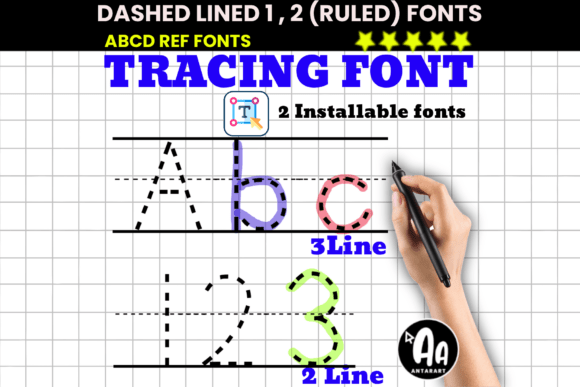
At first glance, Dashed Lined Ruled Tracing appears deceptively simple. It is a creative font designed specifically for handwriting practice, featuring characters that are dashed or dotted rather than solid. However, the true innovation lies in the "ruled" aspect. Unlike standard tracing fonts that require you to manually draw lines in a graphics editor, this typeface comes with built-in guidelines directly integrated into the glyph design.
The set includes two distinct variations: one with 2-line ruling and another with 3-line ruling. This is critical for visual hierarchy in education. The 2-line version typically features a baseline and a midline (or x-height line), which is sufficient for older students or specific practice sheets. The 3-line version adds an ascender/descender line, which is vital for beginners who struggle to differentiate between letters like 'a' and 'h' or 'g' and 'y'. By typing a character, you are simultaneously placing the letter shape and the spatial boundaries on the canvas. This ensures that every letter is perfectly aligned, maintaining the structural integrity required for effective learning.
The personality of this font is utilitarian yet encouraging. It mimics the traditional "school writing" style, making it familiar to students and teachers alike. It supports uppercase and lowercase letters, numbers 0–9, and common symbols, making it a versatile asset for everything from math worksheets to sentence construction. While it does not support Spanish characters, its focus on the English alphabet makes it a robust tool for specific market needs.
Practical Applications: Beyond the Classroom Worksheet
While the primary use case is obvious—creating printable practice sheets for children—the versatility of Dashed Lined Ruled Tracing extends into various sectors of design and entrepreneurship. If you are a small business owner in the educational niche, this font is an essential part of your design assets library. Here is how different professionals can leverage this typeface:
- Educational Publishers and Content Creators: For those creating handwriting workbooks, alphabet practice pages, or back-to-school review packets, this font streamlines the workflow. Instead of manually vectorizing lines for every page, you simply type. This allows for rapid production of high-volume content.
- Stationery and Craft Designers: The font is excellent for creating editable student name templates. Imagine a classroom door decoration where every student’s name is printed on a tracing line. It adds a personalized, professional touch to bulletin board letters and classroom décor.
- Digital Product Entrepreneurs: If you sell resources on platforms like Teachers Pay Teachers or Etsy, offering customizable tracing worksheets is a high-value proposition. Dashed Lined Ruled Tracing allows you to create templates that end-users can edit in Microsoft Word or Canva, adding immense value to your digital product.
- App and Web Designers: For educational apps or websites aimed at children, this font can be embedded to create interactive typing or writing exercises. It brings a tactile, structured feel to the digital screen that standard web fonts lack.
Design Strategy: Integrating Educational Fonts into Professional Projects
When working with a specialized typeface like Dashed Lined Ruled Tracing, the rules of traditional typography—kerning, leading, and tracking—apply differently. The goal is not just aesthetic beauty but functional clarity. As a designer, you must consider how this font influences readability and user engagement. Because the characters are dashed, they rely on the white space between the segments to form the letter shape. Therefore, high contrast is essential. This font works best in black or dark colors against a white or very light background. Avoid placing it over busy textures or images, as this will destroy the legibility of the dashed lines.
Furthermore, consider the font pairing. While Dashed Lined Ruled Tracing is a display font in the sense that it draws immediate attention, it is not meant for body text. You should pair it with a highly legible sans serif font for instructions. For example, use a clean font like Montserrat or Open Sans for the text "Trace the letter below," and then use the Dashed Lined font for the actual letter. This creates a clear visual hierarchy that guides the user's eye from instruction to action.
From a brand identity perspective, if your business focuses on child development or education, using this font signals expertise and a structured approach to learning. It shows that you understand the mechanics of handwriting, which builds trust with parents and educators. It moves your brand away from generic "kiddy" aesthetics toward a more professional, instructional identity.
Technical Compatibility and Workflow Efficiency
One of the most significant advantages of Dashed Lined Ruled Tracing is its seamless integration into existing workflows. It is a premium font designed for ease of use. It is fully compatible with major software suites, including Microsoft Word, PowerPoint, Adobe Illustrator, InDesign, and Photoshop. It also works exceptionally well with popular online tools like Canva Pro, which is a massive time-saver for social media managers and non-designers creating quick graphics.
Installation is standard—simply install the OTF or TTF files on your operating system (Windows or Mac), and the fonts will appear in your font menu. When using the font, you may notice that the line height needs adjustment depending on your software. In some programs, increasing the leading (line spacing) ensures that the bottom rule of one line of text doesn't overlap with the top rule of the next. This is a standard typographic adjustment that ensures your worksheets look clean and professional.
Conclusion: A Tool for Structure and Creativity
In the realm of design assets, functionality often trumps flair. Dashed Lined Ruled Tracing represents the pinnacle of functional typography for education. It solves a specific problem—how to create consistent, guided writing practice materials—with elegance and efficiency. Whether you are a teacher creating a quick activity for your class, a parent homeschooling your child, or a designer building a brand around educational products, this font provides the structural foundation you need. By understanding its features, respecting its technical requirements, and applying it thoughtfully, you can transform simple text into a powerful learning tool that fosters confidence and mastery in young writers.